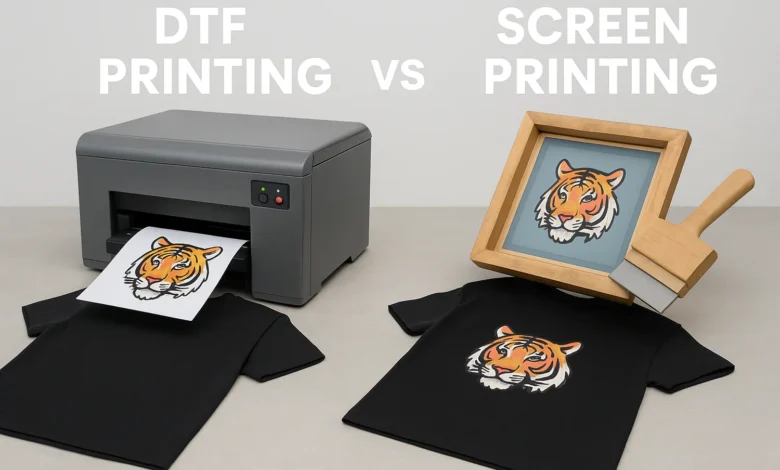
The printing of garments has undergone tremendous changes over the last years. The modern production plants are adopting printing options according to speed, flexibility and consistency in output. The two common methods include Direct-to-Film printing and screen printing. Although the two are working in the same sector, the clothing business, their operations and performance vary significantly.
The knowledge of their differences enables the production teams to choose the most suitable printing method. It depends on the volume of orders, the complexity of design, and the turnaround expectations.
What Is DTF Printing?
- DTF is abbreviated as Direct-to-Film printing.
- The designs are printed on a special film rather than on fabric.
- The adhesive powder is then applied and dried on the printed film.
- Once it has been cured, the design is heat-pressed on the clothing.
- DTF printing allows entire colour designs. This printing is appropriate for complicated art.
DTF printers are being considered by many suppliers as a means of managing heterogeneous types of orders without ink swaps and screen changes.
What Is Screen Printing?
- Screen printing is a conventional technology. Ink is forced through a screen of mesh onto fabric.
- A screen is needed to print each colour. It is either manual or semi-automatic, based on the equipment. Preparation of screens needs professional work. Alteration of designs increases the cost and delay.
- Printing is quick once screens have been prepared.
- Screen printing is commonly used when there are large quantities of orders with few colours.
- Screen printing is best suited for mass production.
- There is good ink penetration in the fabric. This causes long-lasting prints.
Workflow Differences between DTF and Screen Printing
- DTF printing has a digital process. Designs are transferred to film without having to be physically set up. There is no need for screens. This saves on preparation time. While screen printing is based on physical screens. Every change in design entails new screens. This is also time-consuming, cleaning and reclaiming screens.
- DTF processes permit on-demand production. Screen printing is inclined to large-scale production.
Cost Structure Comparison
- Screen printing is more expensive in terms of initial cost. DTF printing includes reduced costs of set-up.
- Screens, installation labour, and clean-up costs matter in screen printing. The unit cost is also a declining variable with volume. In DTF printing, each print is done on film, ink and powder. The unit cost is unchanging with quantities.
- DTF is preferred for small and medium orders. Screen printing is preferred when large, uniform orders are involved.
Design Flexibility
- DTF printing allows the use of an unlimited number of colours. While Screen printing is most appropriate with solid colours.
- DTF is more flexible when it comes to facilities that have a high number of design modifications. It is accommodating to tailored orders. While screen printing is effective as long as the designs do not change with time.
Fabric Compatibility
- The transfer adhesives of DTF are compatible with a large variety of fabrics. While the ink of screen printing works on the fabric directly.
- Supported materials for DTF printing are cotton, polyester and blends. While in screen printing, outcomes are different in accordance with the type of fabric.
Space Requirements and Equipment.
Screen printing needs enough room to hold screens. I also require more space for drying and washout facilities. DTF systems are more compact. They need a heat press, printing and curing unit. This allows them to be incorporated into the current facilities easily.
Durability
- The screen printing is identified with long-lasting prints. The ink is absorbed into the piece of clothing and does not fade away easily when washed. DTF prints are applied onto the garment surface. Modern films and powders have enhanced durability. Longevity entails proper curing.
- Large areas can also be softer with screen prints. DTF prints can be slightly heavier, particularly on heavy designs.
Speed and Scalability in production.
- Screen printing is quick after it has been set up. This is advantageous in large runs. But DTF does not introduce set-up delays. This increases its speed in short-run and urgent tasks.
- DTF printing is linear but regular. In Screen printing, it is possible to produce thousands of identical prints within a very short period of time.
Choosing the Right Method
- Order patterns determine the decision made. Simple designs with high volume are compatible with screen printing. Detailed designs which are variable are in line with DTF.
- Some facilities use both. This mix strategy enhances responsiveness and the use of resources.
Technical sources like https://www.dtflinko.com/ can be useful to those studying printing technologies and equipment.
Conclusion
DTF printing and screen printing have various production objectives. One is focused on frailty and electronic command. The other is focused on speed at scale.
The choice of the appropriate method cannot be made on the basis of preference, but rather on the basis of operational fit.
The differences between them are also useful in enabling production teams to minimise wastage, enhance scheduling and quality consistency.