The landscape of British higher education is undergoing its most significant shift since the introduction of the Open University in the 1960s. For the modern UK graduate, the traditional “three years on campus” model is no longer the sole gold standard. As we move through 2026, the demand for agility, digital integration, and modularity has transformed flexible learning from a “fallback option” into the primary choice for ambitious professionals.
But what is driving this evolution, and why is the UK graduate population leading the charge toward a more elastic academic framework?
The Data Behind the Shift (2025-2026)
According to recent UK higher education enrollment trends:
- Modular Uptake: There has been a 22% increase in “step-in, step-out” postgraduate enrollments since the 2025 rollout of the Lifelong Learning Entitlement (LLE).
- The ‘Work-Study’ Gap: A 2025 survey of Russell Group graduates found that 68% would choose a “blended” Masters over a traditional one if it meant keeping their full-time salary.
- Employer Sentiment: 4 out of 5 UK recruiters now rank “continuous upskilling” (micro-credentials) as equally important to a candidate’s profile as their initial degree.
1. The Rise of the ‘Earn and Learn’ Culture
The economic reality for UK graduates today is vastly different from that of previous generations. With the rising cost of living in hubs like London, Manchester, and Birmingham, many students are opting to enter the workforce immediately after their undergraduate degrees while simultaneously pursuing postgraduate qualifications.
Flexible learning models encompassing part-time distance learning, evening seminars, and asynchronous digital modules allow graduates to maintain their career momentum without sacrificing academic growth. This “earn and learn” culture isn’t just about financial necessity; it’s about the strategic accumulation of work experience alongside theoretical mastery.
2. Understanding the Gen Z Learning Curve
The current cohort of graduates, predominantly Gen Z, approaches education with a “digital-first” mindset. Having spent their formative years navigating intuitive digital interfaces, they expect their education to be equally accessible and on-demand.
Recent research into understanding the Gen Z learning curve highlights that this generation prioritises “micro-learning” and high-frequency feedback. They are less likely to engage with a two-hour static lecture and more likely to thrive in a hybrid environment where they can consume content at their own pace. For UK universities to remain competitive, they are increasingly adopting these flexible frameworks to align with how the modern brain actually processes information.
3. The Shift from Degrees to ‘Stackable’ Credentials
In the UK job market, employers are shifting their gaze toward specific skill sets rather than just the name of a degree. This has given rise to “stackable credentials” or micro-credentials. Instead of committing to a full two-year Masters, many graduates are now taking individual modules that can eventually be “stacked” into a full qualification.
Flexible learning supports this by allowing students to:
- Focus on niche modules: Taking a single course in Data Analytics or Digital Ethics.
- Bridge skill gaps: Quickly upskilling to meet a specific job requirement.
- Control the timeline: Completing a qualification over five years instead of one, depending on life commitments.
4. Overcoming the ‘Time Poverty’ of Postgraduate Life
One of the greatest “red flags” for students considering further study is the fear of burnout. UK postgraduates often juggle family responsibilities, full-time jobs, and social lives. Traditional, rigid timetables often lead to high dropout rates because “life gets in the way.”
Many students now seek professional academic coaching and peer mentorship for online class help. By utilizing these strategic support systems such as dedicated subject-matter tutors and time-management consultants, students can maintain their mental health while meeting the rigorous standards of UK institutions.
5. The Role of AI and EdTech in British Classrooms
By 2026, Artificial Intelligence (AI) has moved from a classroom disruption to a fundamental tool. Flexible learning models leverage AI to provide personalised tutoring and 24/7 support. In the UK, where student-to-tutor ratios can be high, digital flexibility allows for a more tailored experience.
Predictive analytics can now identify when a student is struggling with a particular module, prompting the system to offer additional resources or suggest a change in study pace. This level of personalisation is simply impossible in a traditional “one-size-fits-all” lecture hall.
6. Geographic Levelling Up: Beyond the Campus Walls
The UK government’s “Levelling Up” agenda is inadvertently supported by flexible learning. Previously, high-quality postgraduate education was concentrated in major cities. A graduate living in rural Wales or the Scottish Highlands would have to relocate to access a top-tier university.
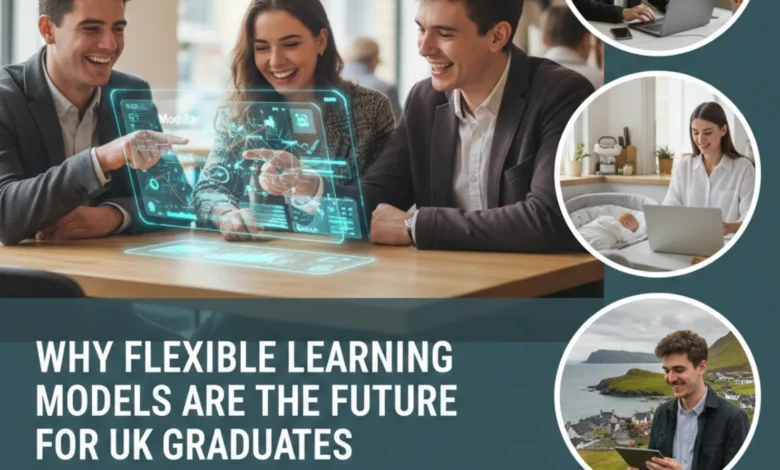
Digital-first flexible models have “democratised” prestige. A student can now live in a coastal town while studying at a world-class institution in Leeds or Bristol. This mobility allows graduates to stay within their communities, contributing to local economies while gaining global-standard qualifications.
7. Challenges and the Path Forward
While the future is undoubtedly flexible, it is not without challenges. The “Digital Divide” remains a concern, where students without high-speed internet or modern hardware may feel left behind. Furthermore, the lack of face-to-face socialisation can lead to feelings of isolation.
To combat this, UK universities are developing “blended” models, the best of both worlds. This involves online theoretical study paired with intensive, in-person weekend workshops or “networking residencies.” This hybridity ensures that while the learning is flexible, the human connection remains intact.
Conclusion: A New Era of Academic Freedom
The move toward flexible learning is not a temporary trend; it is a permanent restructuring of how we define “the student experience.” For UK graduates, this means more autonomy, better career integration, and a more personalised path to success.
By embracing modern learning styles and utilising the digital tools available—from advanced LMS platforms to supplemental academic support, today’s graduates are better equipped than ever to face the complexities of the modern workforce. The future of UK education isn’t found in a specific building; it’s found in the flexibility to learn anywhere, at any time.
Frequently Asked Questions
1. How does flexible learning differ from traditional postgraduate study in the UK?
Traditional postgraduate study usually requires fixed attendance at a university campus. Flexible learning, however, allows you to study via “asynchronous” methods—meaning you can watch recorded lectures and complete modules at times that suit your work or family schedule. This model is increasingly popular with UK graduates who need to balance professional growth with financial stability.
2. Is a degree earned through flexible learning valued by UK employers?
Yes. In the UK, certificates for online or flexible degrees are identical to those earned on-campus. Employers such as those in the Civil Service, NHS, and private sectors like STEM and Finance increasingly value the time-management skills and self-discipline demonstrated by students who successfully navigate the Gen Z learning curve through remote or hybrid study.
3. Can I get financial support for flexible or online modules in the UK?
Most UK universities offer pro-rata tuition fees for modular study. Furthermore, from 2026, the Lifelong Learning Entitlement (LLE) provides a flexible loan system for students in England, allowing them to wrap funding around individual modules rather than committing to a full three-year debt upfront.
4. What should I do if I struggle to balance a full-time job with my online modules?
Experts recommend setting strict “study blocks” and utilizing academic support services. Many successful students engage with subject-specific mentors or study-skills coaches to help them navigate complex material efficiently. This allows graduates to bridge the gap between their workplace responsibilities and high-level academic expectations.
5. Are there “live” elements in flexible learning programmes?
While many programmes are pre-recorded, most UK institutions include “Synchronous” elements like live webinars, Q&A sessions with tutors, and digital breakout rooms. This ensures that while you have flexibility, you still benefit from the peer-to-peer networking that is essential for postgraduate success.
About the Author:
Eleanor Vance is a career strategist and academic researcher who has spent the last decade tracking the intersection of the UK job market and further education. She is a frequent contributor to education blogs, focusing on the practical challenges faced by Gen Z graduates. Eleanor is a strong advocate for flexible learning pathways that bridge the gap between traditional degrees and professional skill sets.