Navigator Pear: Essential Size, Growth and Care Guide
Learn about its mature size, white flowers, cold hardiness, planting needs, fruit, diseases, and best landscape uses.

Introduction
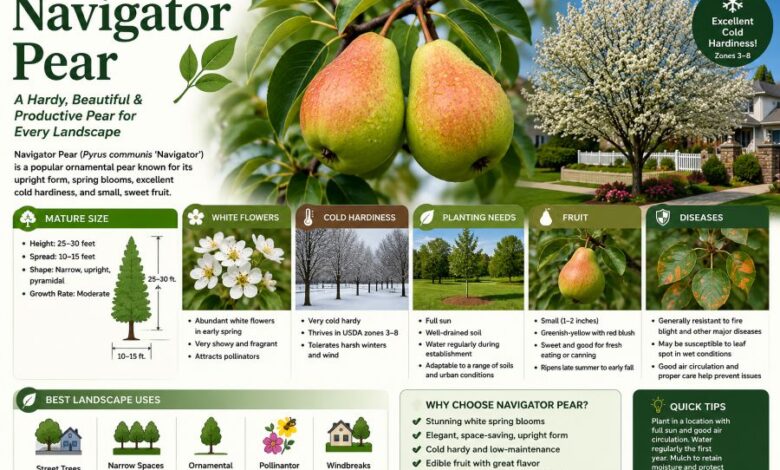
Navigator Pear is a cold-hardy ornamental tree valued for its upright shape, white spring flowers, glossy green foliage, and yellow-orange autumn colour.
It is mainly planted for decoration and landscape structure. Unlike an edible pear tree, it is not selected to produce a useful crop of large pears.
Navigator Pear is best suited to gardeners who want a flowering tree with a tidy, vertical form and strong seasonal interest.
Navigator Pear Quick Facts
| Feature | Details |
|---|---|
| Common name | Navigator Pear |
| Other name | Navigator Ornamental Pear |
| Botanical name | Commonly listed as Pyrus × ‘DurPSN303’ |
| Plant type | Deciduous ornamental tree |
| Mature height | Approximately 23 to 35 feet |
| Mature spread | Approximately 10 to 18 feet |
| Growth habit | Dense, upright and pyramidal |
| Flower colour | White |
| Blooming period | Early to mid-spring |
| Summer foliage | Glossy dark green |
| Autumn colour | Yellow to orange |
| Fruit | Small or minimal ornamental fruit |
| Sun requirement | Full sun |
| Soil requirement | Moist but well-drained soil |
| Hardiness | Commonly listed for Zones 2 or 3 |
| Main uses | Vertical accent, front garden, formal row and shade |
Mature-size estimates differ between nurseries. Climate, soil, available root space, maintenance, and growing conditions can all affect the final size.
What Is Navigator Pear?
Navigator Pear is an ornamental pear cultivar developed for cold climates and organised landscape designs.
Canadian nurseries commonly identify the cultivar as Pyrus × ‘DurPSN303’. Buyers should still check the plant label because catalogue names and descriptions may vary between suppliers.
The tree has a dense, pyramidal crown that grows taller than it grows wide. This form makes it useful where a broad shade tree would take up too much horizontal space.
It is not primarily a fruit tree. Its main value comes from its spring flowers, summer leaves, autumn colour, and upright winter structure.
Navigator Pear Size and Growth Habit
Most nursery listings place the mature height between approximately 23 and 35 feet.
The expected spread ranges from around 10 to 18 feet. Some suppliers publish slightly larger measurements for trees growing under favourable conditions.
Its crown is generally described as upright, dense, and pyramidal. It brings height to a landscape without developing the very broad canopy found on many traditional shade trees.
However, it should not be treated as a miniature tree. It still needs enough room for its branches, trunk, and roots to develop properly.
Do not plant it directly beneath overhead cables or too close to buildings, fences, drainage systems, or paved areas.
Seasonal Appearance
One reason people choose this tree is its changing appearance throughout the year.
White Spring Flowers
Bright white flowers appear in early or mid-spring.
The blossoms usually cover much of the crown, giving the tree a fresh and noticeable display before its full summer foliage develops.
The exact flowering time depends on the local climate and spring temperatures.
Glossy Summer Foliage
After flowering, the tree develops dense green leaves with a glossy surface.
The foliage helps maintain a clean, formal appearance throughout the warmer months.
Its upright canopy can also provide some shade without spreading across an extremely wide area.
Yellow-Orange Autumn Colour
The green leaves usually change to shades of yellow and orange during autumn.
Colour intensity can vary according to sunlight, temperature, moisture, and seasonal weather.
This autumn display gives the tree a second period of visual interest after the spring flowers have disappeared.
Winter Structure
Once the leaves fall, the upright branch framework remains visible.
Its controlled outline can continue adding height and structure to formal gardens during winter.
Does Navigator Pear Produce Edible Fruit?
Navigator Pear should be viewed as an ornamental tree rather than a source of edible pears.
Some specimens may form small fruit after flowering. Jeffries Nurseries describes the fruit as approximately one inch across, while another nursery describes fruit production as minimal.
These small fruits are not comparable to the large pears produced by recognised eating varieties.
Gardeners who want fruit for harvesting should select an edible pear cultivar suited to their climate and pollination requirements.
Those who mainly want white flowers, autumn colour, and an upright tree may find the ornamental form more suitable.
Best Climate and Hardiness Zones
Navigator Pear is promoted as an extremely cold-hardy ornamental tree.
Several Canadian suppliers list it for Hardiness Zone 2, while others place it in Zone 3. This difference may result from regional testing, supplier guidance, or different hardiness systems.
Its cold tolerance makes it especially relevant to gardeners in northern climates where some other flowering pear varieties may not perform reliably.
Hardiness does not mean the tree will thrive in every location. Summer heat, drought, humidity, drainage, and soil quality also affect long-term health.
Buy from a nursery familiar with local winters and growing conditions.
Light and Soil Requirements
Plant the tree in full sun for the strongest flowering, dense growth, and best autumn colour.
A position receiving at least six hours of direct sunlight is normally preferable.
The soil should hold enough moisture to support growth while allowing excess water to drain away.
Bron and Sons Nursery describes Navigator Pear as preferring moist, well-drained soil with a higher pH.
This means it should not be described as completely unaffected by soil conditions. A difficult site may need to be assessed before planting.
Avoid low areas where water remains around the roots after rainfall.
How to Plant Navigator Pear
Choose the planting position according to the tree’s mature size, not the size of the young nursery plant.
Dig a hole wider than the root ball but no deeper than necessary.
Locate the root flare, which is the point where the trunk begins widening into the main roots. It should remain visible close to the finished soil level.
A tree planted too deeply can experience reduced root oxygen, trunk decay, weak growth, and long-term stability problems.
Remove the container and inspect the root system. Loosen or correct tightly circling roots before placing the tree in the hole.
Backfill with the original soil unless local soil conditions require professional amendment.
Water slowly after planting to settle the soil around the roots.
Mulching the Root Area
Spread a shallow layer of organic mulch around the root zone.
Mulch can reduce water loss, limit grass competition, and protect the soil from rapid temperature changes.
Keep it several inches away from the trunk.
Do not pile mulch against the bark in a tall mound. This practice can trap moisture, hide decay, and encourage roots to grow around the trunk.
A wide, shallow mulch ring is better than a deep “mulch volcano.”
Watering Requirements
A newly planted tree needs regular moisture while its roots establish in the surrounding soil.
Water deeply across the root area rather than lightly wetting only the surface.
Check the soil before watering again. It should remain reasonably moist but not permanently soaked.
Hot weather, wind, sandy soil, and limited rainfall can increase the need for watering.
Heavy clay soil may hold water for longer and can create problems if irrigation is too frequent.
An established tree may tolerate short dry periods, but prolonged drought can cause leaf stress, early leaf drop, and weak growth.
Fertilising Navigator Pear
Do not fertilise automatically just because the tree has recently been planted.
Healthy leaf colour and steady annual growth usually show that the tree is receiving enough nutrients.
A soil test is the best way to identify a genuine nutrient problem.
Too much nitrogen can create soft, fast growth that is harder to manage and may be more vulnerable to disease.
Poor drainage, planting depth, root damage, drought, and compacted soil can also cause slow growth or yellow leaves.
Identify the cause before applying fertiliser.
Pruning and Maintenance
The tree naturally develops a controlled, upright crown, so heavy pruning should not be required.
Remove dead, broken, rubbing, or badly positioned branches when necessary.
Most structural pruning should be completed while the tree is dormant and before active spring growth begins.
Young specimens may benefit from careful training to establish one strong central leader and well-spaced branches.
Avoid cutting away a large part of the canopy in one season.
Severe pruning can damage the natural form and encourage clusters of weak, fast-growing shoots.
Large branches or work near buildings and cables should be handled by a qualified tree professional.
Fire Blight and Other Possible Problems
Fire blight is a bacterial disease that can affect pear trees and other members of the rose family.
The competing article claims that this cultivar resists fire blight, but reliable cultivar-specific evidence for that statement is limited. It is safer not to present Navigator Pear as immune or strongly resistant.
Possible symptoms include:
- Blackened shoots
- Wilted flowers
- Dark leaves that remain attached
- Sunken branch cankers
- Curved shoot tips resembling a shepherd’s crook
Warm, wet weather during flowering can support disease development.
Heavy nitrogen feeding and severe pruning can also create soft new shoots that are more vulnerable to infection.
A suspected case should be correctly diagnosed before treatment or pruning begins.
Other possible issues include leaf spots, root stress, yellow foliage, branch damage, and early leaf fall.
These symptoms may result from disease, but they can also be caused by poor drainage, drought, compacted soil, deep planting, or damaged roots.
Best Landscape Uses
The upright crown gives Navigator Pear several practical landscape uses.
Front-Garden Feature
A single tree can become a vertical focal point in a front lawn or large planting bed.
It brings white flowers in spring and warm foliage colour in autumn.
Driveways and Entrances
Its pyramidal form can work near entrances where an extremely wide canopy would become inconvenient.
Enough distance must still be left between the tree and paving, structures, or vehicle access.
Formal Rows
Several trees planted at equal distances can create a formal avenue or repeated landscape pattern.
This approach may suit large properties, business sites, paths, and organised public spaces.
Narrower Landscapes
The tree may fit narrower spaces better than a broad shade tree.
However, the largest published spread is close to 18 feet, so accurate spacing remains important.
Mixed Planting Designs
It can be combined with shrubs, ornamental grasses, spring bulbs, and low-growing perennials.
Avoid placing aggressive plants directly over the young root system.
Navigator Pear vs an Edible Pear Tree
| Feature | Navigator Pear | Edible pear tree |
|---|---|---|
| Main purpose | Flowers, foliage and landscape form | Producing edible pears |
| Fruit | Small or minimal | Larger harvestable fruit |
| Growth habit | Upright and pyramidal | Varies by cultivar |
| Pollination planning | Not important for ornamental value | Often important for fruit production |
| Main maintenance goal | Healthy structure and appearance | Tree health and fruit production |
| Best buyer | Someone wanting an ornamental tree | Someone wanting a pear harvest |
Advantages
Navigator Pear offers several useful qualities:
- Strong cold hardiness
- White spring flowers
- Glossy green foliage
- Yellow-orange autumn colour
- Upright, pyramidal growth
- Small or limited fruit
- Useful form for narrower sites
- Seasonal interest across much of the year
Points to Consider Before Buying
The tree can eventually reach 35 feet under suitable conditions.
Its spread may also be wider than some short product descriptions suggest.
It needs full sun and well-drained soil rather than a permanently wet position.
It is not the correct choice for gardeners who want a dependable edible pear crop.
Like other ornamental pears, it may face bacterial disease, fungal leaf problems, root stress, and weather damage.
Check the exact nursery label, expected mature size, local hardiness guidance, and available planting space before purchasing.
Frequently Asked Questions
What is Navigator Pear?
It is a cold-hardy ornamental pear grown for white flowers, glossy foliage, autumn colour, and an upright crown.
What is its botanical name?
Most Canadian nursery listings identify it as Pyrus × ‘DurPSN303’.
How tall does it grow?
Published nursery estimates generally range from about 23 to 35 feet.
How wide does it become?
Its mature spread is commonly listed between approximately 10 and 18 feet.
Does it produce edible pears?
It may produce small fruit, but it is not grown as an edible pear variety.
Does it need full sun?
Yes, full sun normally supports stronger flowering, denser foliage, and better autumn colour.
Is it suitable for cold regions?
Yes, nurseries commonly list it for the very cold conditions associated with Zones 2 or 3.
Is Navigator Pear resistant to fire blight?
There is not enough reliable cultivar-specific evidence to describe it as immune or strongly resistant.
Can it grow in a container?
It may remain in a nursery container temporarily, but its mature size makes it unsuitable as a permanent container tree.
How close can it be planted to a house?
Spacing should be based on its potential mature spread, root space, local rules, and access for future maintenance.
Conclusion
Navigator Pear is an ornamental flowering tree with a dense, upright form and strong cold tolerance.
Its white spring blossoms, glossy summer foliage, and yellow-orange autumn colour make it useful as a front-garden feature, vertical accent, or formal row.
The tree performs best in full sun with moist but well-drained soil and enough room for its mature canopy.
Correct planting depth, careful establishment watering, moderate pruning, and disease monitoring can support healthier long-term growth.
It is a practical option for gardeners seeking seasonal beauty and structure rather than a crop of edible pears.