Ellis Mee: The Meteoric Rise of a Welsh Rugby Union Player Who Defied the Odds
From university pitches to international glory – the inspiring journey, challenges, and triumphs of Ellis Mee

Introduction
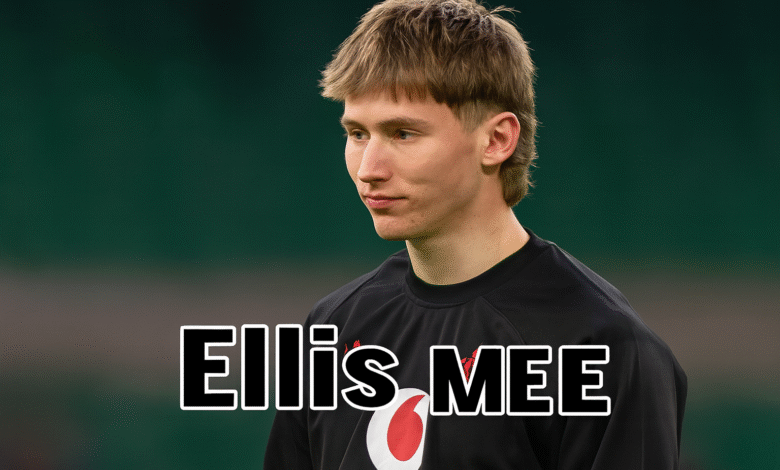
Ellis Mee’s journey from a student at Nottingham Trent University to a celebrated Welsh rugby union player is nothing short of remarkable. In just a few years, he transitioned from playing university rugby to representing Wales on the international stage, impressing fans and critics alike with his skill, determination, and rapid development.
While his rise has been met with widespread admiration, it has not been without challenges. The leap from university-level matches to professional and international rugby brought intense pressure, yet Mee’s ability to adapt, deliver strong performances, and maintain focus has set him apart as one of the brightest prospects in Welsh rugby.
Quick Bio
| Full Name | Ellis Mee |
|---|---|
| Date of Birth | 6 October 2003 (Age 21) |
| Birthplace | Nottingham, England |
| Nationality | English-born, qualifies for Wales |
| Education | Nottingham Trent University (Sports Science & Management) |
| Early Life | Lived in Adelaide, Australia; played youth rugby in England |
| Parents | Mother from Newport, Father Tony (deceased) |
| Career Start | BUCS Rugby → Nottingham RUFC (2023) |
| Club Career | Nottingham RUFC, Scarlets |
| International | Wales debut in 2025 Six Nations |
| Awards | Multiple Nottingham awards; Scarlets’ Breakthrough Player |
Early Life and Education
Ellis Mee was born on 6 October 2003 in Nottingham, England, but his story quickly took a global turn. During his early childhood, he lived in Adelaide, Australia, where he was first introduced to rugby. This international upbringing gave him a unique perspective on the sport and helped shape his adaptability as a player.
Returning to England at the age of eight, Mee immersed himself in local rugby clubs, playing for Keyworth RFC and West Bridgford RFC. Alongside his athletic development, he pursued his education at South Nottinghamshire Academy before enrolling at Nottingham Trent University, where he studied Sports Science and Management—a course that complemented his athletic ambitions.
Start of Rugby Career
Unlike many professional players, Mee did not come through a traditional rugby academy. Instead, he honed his skills in BUCS Super Rugby competitions, representing Nottingham Trent University against some of the strongest university teams in the UK. His exceptional performances at the university level caught the attention of Nottingham RUFC, opening the door to professional rugby.
In August 2023, he made his debut for Nottingham in the RFU Championship. Despite being a newcomer, Mee quickly made an impact, combining speed, agility, and intelligent decision-making to stand out in a competitive league.
Nottingham RUFC Achievements
During his debut season with Nottingham, Mee proved to be a prolific try-scorer. Over 22 appearances, he scored approximately 35 points, earning a reputation as one of the club’s most exciting players.
His efforts were rewarded with three major accolades: Fans’ Player of the Season, Players’ Player of the Season, and Overall Player of the Season. These honors not only cemented his status as a rising star but also highlighted his influence on and off the pitch.
Transition to Scarlets
In May 2024, Mee signed with the Scarlets, a prominent Welsh club competing in the United Rugby Championship. The move marked a significant step in his career, aligning him more closely with the Welsh rugby system and strengthening his chances of international selection.
His Scarlets debut came in a preseason fixture on 31 August 2024, followed by a competitive debut on 21 September against Benetton. Within months, he scored his first try for the club against the Ospreys and another in the following match against the Dragons, showcasing his consistency and attacking threat.
Breakthrough at International Level
Mee’s eligibility for Wales, through his mother’s heritage, became the key to his international breakthrough. In January 2025, he received his first call-up to the Wales national team for the Six Nations Championship.
He made his debut against Ireland in February 2025. The match was memorable not just for the cap itself but for his near-try—only denied by the narrowest of margins. His powerful runs, fearless tackling, and composure under pressure earned comparisons to Welsh great George North.
Playing Style and Strengths
Ellis Mee is known for his versatility, capable of playing both wing and full-back positions. His height (1.93m) and speed make him a constant aerial and running threat. Offensively, he blends raw power with sharp footwork, while defensively, his awareness and tackling ability ensure stability in the backline.
His background at Nottingham Trent University and his unconventional rise have given him a strong mental game. He is adaptable, disciplined, and able to thrive under the intensity of top-level rugby—a combination that is rare for players his age.
Awards and Recognition
In addition to his Nottingham accolades, Mee’s debut Scarlets season earned him the Coaches’ Breakthrough Player of the Season award. His performances have been praised by coaches, teammates, and fans, positioning him as a player to watch in the coming years.
Conclusion
Ellis Mee’s journey from university pitches to representing Wales at the Six Nations is a testament to talent, perseverance, and seizing opportunities. His career trajectory is not just inspiring—it is redefining what is possible for young players outside traditional development pathways.
As he continues to develop with the Scarlets and Wales, rugby fans are eager to see how far his talent can take him. If his current momentum continues, Ellis Mee may well become one of the defining players of his generation.
FAQ
Q1: When was Ellis Mee born?
A: Ellis Mee was born on 6 October 2003 in Nottingham, England.
Q2: Which university did Ellis Mee attend?
A: He studied Sports Science and Management at Nottingham Trent University.
Q3: Which clubs has Ellis Mee played for?
A: He has played for Nottingham RUFC and Scarlets.
Q4: When did Ellis Mee make his international debut for Wales?
A: He debuted in the 2025 Six Nations Championship against Ireland.
Q5: What positions does Ellis Mee play?
A: He plays as a wing and full-back.